 rus
rus


Portrait of The Company
D. S. Chekhanovsky
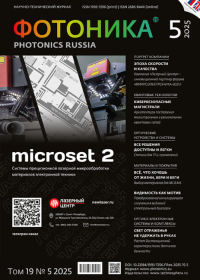
Innovative Partner of the “Microelectronics 2025” Forum – Laser Center DOI: 10.22184/1993-7296.FRos.2025.19.5.340.343
The domestic microelectronics industry comprises a wide range of developers and manufacturers, each of which has its own specialization. Achievement of the technological sovereignty in the field of microelectronics is impossible without active development and improvement of the specialized processing equipment. How can the standard microelectronics production processes be combined with the advanced laser technologies in a single system? This is precisely the question answered by the laser equipment produced by Laser Center. The company manufactures the equipment for electronic engineering that successfully implements various processes such as demetallization, scribing, green ceramics processing, piercing of corundum ceramics and ferrite, and mesa structuring of semiconductor materials. Laser Center acts as an innovation partner for the Microelectronics‑2025 forum. In his interview, Head of the supply department of the company Denis Sergeevich Chekhanovskiy highlighted the advantages of laser equipment for manufacturing of the electronic products. Beyond the user convenience, this equipment ensures high reproducibility of results, leading to the increased the efficiency and competitiveness of the our microelectronics industry.
Innovative Partner of the “Microelectronics 2025” Forum – Laser Center DOI: 10.22184/1993-7296.FRos.2025.19.5.340.343
The domestic microelectronics industry comprises a wide range of developers and manufacturers, each of which has its own specialization. Achievement of the technological sovereignty in the field of microelectronics is impossible without active development and improvement of the specialized processing equipment. How can the standard microelectronics production processes be combined with the advanced laser technologies in a single system? This is precisely the question answered by the laser equipment produced by Laser Center. The company manufactures the equipment for electronic engineering that successfully implements various processes such as demetallization, scribing, green ceramics processing, piercing of corundum ceramics and ferrite, and mesa structuring of semiconductor materials. Laser Center acts as an innovation partner for the Microelectronics‑2025 forum. In his interview, Head of the supply department of the company Denis Sergeevich Chekhanovskiy highlighted the advantages of laser equipment for manufacturing of the electronic products. Beyond the user convenience, this equipment ensures high reproducibility of results, leading to the increased the efficiency and competitiveness of the our microelectronics industry.
Opto-electronic systems and complexes
M. V. Ostanin, D. G. Otkupman, M. V. Shakhmatov
Parameter Selection Methods for the Basic Range Sensors and Determination of Its Range Characteristic DOI: 10.22184/1993-7296.FRos.2025.19.5.390.399
FSBEI HE “Moscow State University of Geodesy and Cartography” (MIIGAiK), Moscow, Russia
The parameter selection methods for the onboard basic automatic active optical range sensors and determination of its range characteristic are considered. The paper provides for the dependences and influence of the base value, focal distance and the circle of confusion value on the relative response error of range sensors, as well as selection of these parameters at a given relative error and response distance. The models and optical circuits of the sensors based on a photo- and laser diode developed according to the established method are shown.
Parameter Selection Methods for the Basic Range Sensors and Determination of Its Range Characteristic DOI: 10.22184/1993-7296.FRos.2025.19.5.390.399
FSBEI HE “Moscow State University of Geodesy and Cartography” (MIIGAiK), Moscow, Russia
The parameter selection methods for the onboard basic automatic active optical range sensors and determination of its range characteristic are considered. The paper provides for the dependences and influence of the base value, focal distance and the circle of confusion value on the relative response error of range sensors, as well as selection of these parameters at a given relative error and response distance. The models and optical circuits of the sensors based on a photo- and laser diode developed according to the established method are shown.
Tags: energy efficiency function laser range sensors range characteristic reference distance базовое расстояние дистанционная характеристика лазерные датчики дальности функция энергетической эффективности
Optical Devices & Systems
G. I. Kropotov, D. A. Popov, D. I. Tsypishka, A. A. Shakhmin
Optics for Terahertz Applications DOI: 10.22184/1993-7296.FRos.2025.19.5.364.376
The article discusses the production features of the optical elements for application in the THz range devices and equipment, describes the properties and specifications of optical materials for its production, and provides the application examples. Special attention is paid to the elements used exclusively in the THz systems and devices.
Optics for Terahertz Applications DOI: 10.22184/1993-7296.FRos.2025.19.5.364.376
The article discusses the production features of the optical elements for application in the THz range devices and equipment, describes the properties and specifications of optical materials for its production, and provides the application examples. Special attention is paid to the elements used exclusively in the THz systems and devices.
Tags: fresnel’s lenses f-theta lenses f-theta линзы optical elements for the terahertz range terahertz (thz) radiation линзы френеля оптические элементы для терагерцевого диапазона терагерцевое излучение
G. V. Simonenko
π-Cell Based Liquid Crystal Modulator for THz Measurements DOI: 10.22184/1993-7296.FRos.2025.19.5.378.388
This article presents the development of a computer model for calculating the optical specifications of a liquid crystal modulator. It allows considering multipath interference in the device with acceptable approximations and does not require any significant computational costs. The performance analysis of a THz radiation modulator based on a multicellular liquid crystal structure is performed.
π-Cell Based Liquid Crystal Modulator for THz Measurements DOI: 10.22184/1993-7296.FRos.2025.19.5.378.388
This article presents the development of a computer model for calculating the optical specifications of a liquid crystal modulator. It allows considering multipath interference in the device with acceptable approximations and does not require any significant computational costs. The performance analysis of a THz radiation modulator based on a multicellular liquid crystal structure is performed.
Tags: liquid crystal structure thz radiation modulator жидкокристаллическая структура модулятор тгц-излучения
Quantum Technologies
A. V. Gleim, K. S. Samburskaya, K. V. Smirnov
Trunk and Regional Quantum Network Architecture DOI: 10.22184/1993-7296.FRos.2025.19.5.348.362
The article considers the applicable approaches to the implementation of quantum communications networks in Russia, its architecture, including any relations between the individual elements or levels in the context of available statutory regulations of the quantum communications industry and its common use. The main relevant concepts and definitions are provided.
Trunk and Regional Quantum Network Architecture DOI: 10.22184/1993-7296.FRos.2025.19.5.348.362
The article considers the applicable approaches to the implementation of quantum communications networks in Russia, its architecture, including any relations between the individual elements or levels in the context of available statutory regulations of the quantum communications industry and its common use. The main relevant concepts and definitions are provided.
Tags: qkd quantum receiver qkd transmitter quantum communications quantum key distribution (qkd) quantum network quantum-protected communication network квантовая сеть квантовое распределение ключей квантовозащищенная сеть связи квантовые коммуникации квантовый передатчик квантовый приемник
Materials & Coatings
I. O. Dryagin, A. N. Manin, A. P. Gorshkova, N. L. Istomina
Choice of Materials for Creating Micro-OptoElectromechanical Switches for Next-Generation Communication Systems DOI: 10.22184/1993-7296.FRos.2025.19.5.400.406
The paper discusses the selection of materials for micro-opto-electromechanical switches (MOEMS) used in new generation communication systems. The focus is on the optical and electrical characteristics of materials, such as dielectric permittivity, refractive index, and bandgap. A study of the effect of these parameters on the efficiency of optical systems is carried out. Machine learning methods were used to predict the properties of materials, and promising materials with high dielectric permittivity were identified. The results obtained can be useful in the development of new methods for designing optical and radio-frequency communication components.
Choice of Materials for Creating Micro-OptoElectromechanical Switches for Next-Generation Communication Systems DOI: 10.22184/1993-7296.FRos.2025.19.5.400.406
The paper discusses the selection of materials for micro-opto-electromechanical switches (MOEMS) used in new generation communication systems. The focus is on the optical and electrical characteristics of materials, such as dielectric permittivity, refractive index, and bandgap. A study of the effect of these parameters on the efficiency of optical systems is carried out. Machine learning methods were used to predict the properties of materials, and promising materials with high dielectric permittivity were identified. The results obtained can be useful in the development of new methods for designing optical and radio-frequency communication components.
Tags: диэлектрическая проницаемость искусственные материалы машинное обучение микро-опто- электромеханические переключатели (моэмс) оптические компоненты систем связи показатель преломления ширина запрещенной зоны
S. E. Sarkisov, V. A. Yusim, D. N. Chausov
Crystal Scintillator With a Sensitized Circuit for Converting Ionizing Radiation Into the Visible Spectral Band DOI: 10.22184/1993-7296.FRos.2025.19.5.408.418
The inorganic compounds based on crystalline solid solutions are proposed as the materials for visually observable transformation of ionizing radiation. The energy spectra of Ca1‑xLuxF2+x: Eu2+ crystals have showed that the light output is consistently increased upon an increase in the parameter Zeffect related to the advanced LuF3 content. The efficient excitation energy transfer between the impurity rare-earth ions Eu2+ and Pr3+ in the mixed crystals of Ca1‑xLuxF2+x synthesized by the horizontal directional crystallization has been studied. The results of luminescence studies during registration of the γ-, X-ray and short-wave UVC radiation confirm the process of excitation energy transfer from the Eu2+ ions to Pr3+ in Ca1‑xLuxF2+x and allow to consider the Eu2+ ions as an efficient sensitizer of Pr3+ ions. The sensitization-enhanced radiation of Pr3+ ions converts the UV radiation of Eu2+ excited by the γ-quanta into the visible spectral band.
Crystal Scintillator With a Sensitized Circuit for Converting Ionizing Radiation Into the Visible Spectral Band DOI: 10.22184/1993-7296.FRos.2025.19.5.408.418
The inorganic compounds based on crystalline solid solutions are proposed as the materials for visually observable transformation of ionizing radiation. The energy spectra of Ca1‑xLuxF2+x: Eu2+ crystals have showed that the light output is consistently increased upon an increase in the parameter Zeffect related to the advanced LuF3 content. The efficient excitation energy transfer between the impurity rare-earth ions Eu2+ and Pr3+ in the mixed crystals of Ca1‑xLuxF2+x synthesized by the horizontal directional crystallization has been studied. The results of luminescence studies during registration of the γ-, X-ray and short-wave UVC radiation confirm the process of excitation energy transfer from the Eu2+ ions to Pr3+ in Ca1‑xLuxF2+x and allow to consider the Eu2+ ions as an efficient sensitizer of Pr3+ ions. The sensitization-enhanced radiation of Pr3+ ions converts the UV radiation of Eu2+ excited by the γ-quanta into the visible spectral band.